
Behind the outward form of Freemasonry is an interior work: the refinement of the man himself. Through symbol, fellowship, and ritual, the Craft points each Brother toward self-knowledge, moral discipline, and the search for Light.
Origins
Freemasonry traces its ancestry to the operative crafts which, records indicate, were introduced into England as early as 674 A.D. Freemasonry is directly descended from those associations of operative stonemasons, primarily the cathedral builders of the Middle Ages. These master craftsmen, because of their special knowledge and skills, were privileged to travel from country to country, employing the secrets and skills of their craft. They developed means of recognition and identification of their work.
In the 17th and early 18th centuries, membership in the Fraternity was confined to men who were engaged in the actual design, supervision, and construction of buildings and, for the most part, were members of operative stonemason guilds or lodges. From the early 1700s, non-operative Masons were admitted, and it was from this situation that theoretical and symbolic Masonry, called speculative Masonry, developed. Gradually, the lodges came to be composed almost entirely of these accepted or speculative Masons. From these groups, the Freemasonry of today had its beginning.
An Introduction to the Craft
Freemasonry is the oldest and largest fraternal order in the world and is active in virtually every free country. It is a society of friends and brothers and thus is limited to men of sound mind and good character who, in Ontario, have reached the age of twenty-one years. The Fraternity does not solicit members; a man must seek membership of his own free will and accord. The desire to become a Mason must come from within.
Freemasonry is a fraternity of men who share a firm belief in the existence of a Supreme Being. The main qualification for joining the Fraternity is that an applicant believes in a Supreme Being and a future existence. Freemasonry is a fraternity of men of good principle and character, resulting in strong bonds of friendship between men of the same nature who might otherwise have remained strangers. It regards all men as equals and recognizes no distinctions of rank or class.
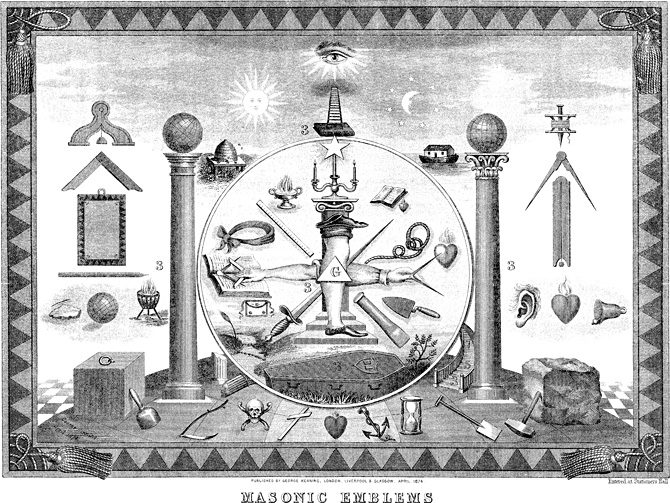
It is a serious fraternity, which conducts its formal ceremonies in the Lodge rooms with high dignity and without frivolity. The ceremonies are often considered by Masons to have been among the most moving experiences of their lives. Employing the tools of the stonemason as symbols of basic moral truths, Masonic ceremonies dramatize a philosophy of life based on morality.
At other times, Freemasonry encourages debate and discussion, except on matters of creed, race, religion, politics, or other topics likely to excite personal animosities or disharmony among the members. Freemasonry is not an insurance or benefit society. It is not organized for profit. It is not a charitable institution, although it does assist its members by many means through times of hardship, and its membership is taught to be of service to mankind.
Religion and Freemasonry
Freemasonry is neither a religion nor a substitute for one. Freemasonry has no dogma, no priesthood, and no plan for salvation. Neither is it an offshoot of any church, synagogue, mosque, or religious group, ancient or modern. It espouses none of them, nor is it subservient to any.
While Freemasonry does require a belief in a Supreme Being, each Mason may worship according to his own religious belief. It has a philosophy of its own which is compatible with the teachings of religious institutions. The teachings of Freemasonry transcend all denominational and sectarian divisions.
In the field of human conduct, it is complementary to religion, but, as has been said, religious topics may not be discussed.
The names used for the Supreme Being enable men of different faiths to join in prayer, to God as each sees Him, without the terms of the prayer causing dissension among them. There is no separate Masonic God; a Freemason’s God remains the God of the religion he professes. The Bible, referred to by Masons as the Volume of the Sacred Law, is always open at every Masonic meeting. Where members of a lodge belong to different faiths, other sacred volumes, such as the Koran and Torah, may be open alongside the Bible.

Freemasonry in Society
Freemasonry is not connected in any way with a political creed. A Freemason’s political views are his own, and a lodge may well have members belonging to many different political parties. For that reason, no discussion of political matters is permitted in a lodge. A Brother may not seek to persuade his Brethren in a lodge to adopt this or that view in matters of government, whether local, national, or international. Nor does any lodge endorse candidates of any political persuasion.
A member is charged to be true and loyal to the Head of State and Government of his country, and to be law-abiding. Freemasonry is not a secret society. It does not conceal its existence or activities. Masons are proud of their affiliation. True, it has secrets of its own, such as its methods of recognition and symbolic instruction in its principles.
It is a charitable, benevolent, and educational society. It is charitable in that it is devoted to the promotion of the welfare and happiness of mankind, and not to the profit of any individual or individuals.
It is benevolent in that it teaches ethical principles acceptable to all men: principles such as kindness and faithfulness in the home, honesty and fairness in business and occupation, courtesy in social contacts, help for the weak and unfortunate, forgiveness of the penitent, respect for one another, and, above all, reverence towards a Supreme Being.
It is educational in that it teaches morality and lawfulness, develops self-discipline in thought and action, and builds confidence in communicating and dealing with one’s fellows. It encourages research into its origins, as well as contemplation and discussion of the moral concepts it espouses.
It must be clearly understood by every member of the Craft that his membership does not in any way exempt him from his duty to meet his responsibilities to the society in which he lives. The Charge to the new initiate calls on him to be exemplary in the discharge of his civil duties; this duty extends throughout his private, public, business, and professional life.
A Lifelong Work
Freemasonry is not a shortcut to status, influence, or worldly advantage. It is a path of fellowship, discipline, and moral reflection. Through its symbols, ceremonies, and brotherhood, the Craft encourages a man to examine himself honestly, govern his passions, strengthen his character, and become more useful to those around him.
Its purpose is not to make a man better than others, but to help him become better than he might otherwise have been. For those who approach it sincerely, Freemasonry offers lasting friendship, meaningful tradition, and a lifelong invitation to seek Light, practise virtue, and serve with humility.